
Serialization

A Tale of Two Cities by Charles Dickens. Book 1 Thoughts 🙂

Research Exercise #1

The installment pattern adds another personal history to the novel itself. Realizing that readers first received A Tale of Two Cities in parts rather than as a whole reveals an opposition to static narrativism. History here is not fixed; it is unfolding. It is cyclical progress, interruption, and return. The novel opens with duality, “the age of wisdom, [and] the age of foolishness” (Dickens 5), and serialization mirrors that instability. Each installment offers fragments: glimpses of the ugly face of royalty, chaos in the streets, religious undertones, faith, and fear. Suspense is not just in the plot but in the waiting. The first installment ends with the haunting image of a man buried for eighteen years. There is no resolution, only absence, and the name Mr. Lorry. A serialized reader would have to live in that uncertainty. Reading continuously softens that experience because the explanation follows quickly. Suspense becomes brief instead of sustained.

Reflection and memory function differently as well. Dickens gives us a line, “In any of the burial-places of this city through inhabitants are, in their most innermost personality, to me, or than I am to them” (Dickens 15). Who is harder to read? Who is more impossible to understand, the buried man, the cities, or ourselves? In installments, such questions remain open longer. Readers must remember them across weeks. Memory becomes active labor. When Mr. Lorry says, “‘Recalled to Life’; which may mean anything…” (Dickens 29), the phrase becomes a promise without immediate fulfillment. “Which may mean anything” truly means anything when you cannot turn the page. In a single volume, however, memory is assisted by proximity. You can flip back and move forward, and the gaps shrink. 

 Empathy also stretches under serialization. The introduction of the Defarges and the uneasy calm surrounding Lucie and her father deepen emotional tension. When Monseiur Defarge says, “‘And a beautiful world we live in, when it is possible, and when many other such things are possibly, and not only possible, but done…Long live the Devil. Let us go on’” (Dickens 39), the tone goes from this tenderness to menace. Reading continuously compresses that fragility, each passing moment holding even more weight. The emotional instability has less time to breathe. Each installment reveals growth, not only in characters but in readers. Serialization forces patience, endurance, and participation. Continuous reading offers immersion and control. The difference is not only structural but also experiential. Beneath this structure asks the difficult question of whether resurrection is ever complete, or if history only allows partial returns. Serialization refuses immediate closure and makes readers sit inside that uncertainty.
Abandon Me

By Melissa Febos

This book may have saved the most recent version of me. At the start of every book I’m someone, and at the end I’m someone else.

This book took me four months to finish, and for the first time, “life” wasn’t the reason to stand in my way of finishing it in a timely manner. My body physically could not pick up this book, and mentally I couldn’t get the words into my head.

It feels strange for me to reread books, I have to somehow build up the courage to pick up a book for the second time. I knew once I finished this book it would be one less voice telling me how to go on in this complicated world.

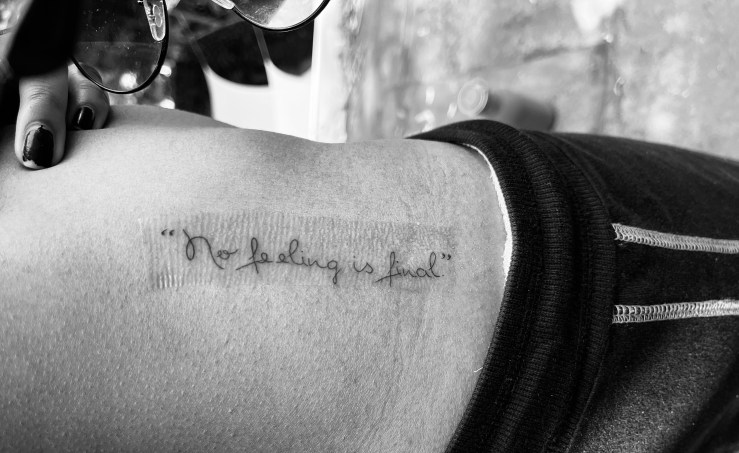
  • “Let everything happen to you: beauty and terror / Just keep going. No feeling is final / Don’t let yourself lose me.” -Rainer Marie Rilke
  • “And comfort eases, but it does not erase. Until then, we keep reading.”
  • “I carried a story of my own into that room but her voice silenced everything in me.”
  • “…we trusted those stories because we could not trust our own.”
  • “It was the only comfort I knew well enough to offer.”
  • “It’s hard to care rightly for someone you fear losing.”
  • “I was both looking for and leaving myself.”
  • “That is, love doesn’t give us a god, unless we are also willing to become one.”
  • “We coo at pregnant bellies, sanctify that most blatant acknowledgment of sex, but shame this ephemeral evidence. A hickey is personal.”
  • “My body has always given me away. Or maybe it’s the other way around.”
  • “Praying to Jesus was not for anyone in our family. But I loved the word mercy. The idea of falling to one’s knees moved something in me that I tended like a secret.”
  • “I said yes and no at all the wrong times.”
  • “…the sweet terror of being recognized.”
  • “I barricaded myself in books and secrets.”
  • “I was afraid to touch him, my little brother, afraid of how badly he might need that.”
  • “For thirty dollars I could go anywhere without fear.”
  • “How could I have defined him by any word that did not include my love for him?”
  • “I have always chosen my poisons. The things that will hurt and grow me the most.”
  • “But the real power here is his, in knowing what he needed and in asking for my help.”
  • “The best we can offer each other, and ourselves, is a few honest words.”
  • “We all want this in love — for our lovers to spot the marks of our losses, the scars that note how we have been changed, how we became the person they love.”
  • “I did not choose my female body. But I chose every image painted on it.”
  • I wish I could tell you what’s wrong with me, I whispered, tears dripping onto my knees. It was a lie and also true.”
  • “The thing about pain is that it pins you to the moment, to your body.”
  • “Believe in this until you can believe in me.”
  • “I still wanted to be a princess, and not for the political power.”
  • “Of course I wanted something to hold onto — I could not hold onto myself.”
  • “It is not easy to be seen, no matter how we crave it.”
  • “Wanting something does not mean it will suit us.”
  • “She wanted love to heal the wounds of her past.”
  • “But what does it mean to be taken care of? Material security. Adoration.”
  • “If he loved us, if he really loves us, where was he?”
  • “A hope that somewhere else might be the truer life or love you have hoped for.”
  • “I understood early that love was a mission to heal one’s own heart.”
  • “Every prayer is answered, I think, though not often in the ways we imagine.”
  • “Our selves are sometimes the only things over which we wield power. And our means of expressing it are sometimes chosen for us.”
  • “It was the kind of story that I’d loved as a girl, when everything seemed tragic and romantic, the kind of story that only ended in a wedding or a funeral.”
  • “The urge to list is an urge to locate and to contain. A list is an attempt to organize the chaos both inside and outside of us into something manageable, finite.”
  • “Love is not a feeling, a fever, or need; ‘Love is as love does.'” – M. Scott Peck
  • The problem with being known is that your people know when you are gone.”
  • “We are in constant collaboration with our contexts.”
  • “And writing was the only way I could think clearly. The thoughts in my mind ran on a loop — they were worried, obsessed, and small. They went nowhere. By building a story, I could find a beginning, middle, and end.”
  • “But feelings have terrible manners — they are like children, or drunks.”
  • Feelings are not facts, they used to say in my meetings, and it was true. But facts had never rescued me and feelings had done their work.”
  • “You must look at the parts that hurt, that do not flatter or comfort you.”
  • “Maybe that’s all bravery is: when your hunger is greater than your fear.”
  • “You cannot erase yourself. You can only abandon it.”
  • “Some burdens can only be measured by their relief.”